The Business of Innovation – Final Part: Valuing Your IP: What Is It Actually Worth?


Throughout my series on IP Asset Management, much has been said about aligning an organization’s IP strategy with its overall business plan. Together, we looked at focusing innovation and development on the technologies, brands and other assets that support that plan; identifying and protecting the IP that matters; and establishing both offensive and defensive strategies around those assets.
Inevitably, someone in the C-suite, a lender or a sponsor—is going to ask the obvious question: what is it worth?
That seemingly simple question takes us into the twilight zone that is the art and science of IP valuation.
Senior management, boards, investors and financial advisers are accustomed to approaching business valuation using three traditional methodologies: the cost approach, the market approach and the income approach. Therefore, the starting point in determining what the IP is worth should always include these familiar methods.
The difficulty is that intellectual property seldom behaves like a conventional business asset. The amount spent developing an invention (the cost approach) may bear little relationship to its ultimate commercial value. Comparable IP transactions (the market approach) may be difficult to find—and even harder to compare. Forecasted income (the income approach) depends upon several factors and assumptions about the class of innovation, the markets, timing, competition, IP strength, technological change and commercial execution that can change dramatically over time. And in terms of apportionment (identifying the part played by the IP in assessing overall value), one must also ask, what exactly was the contribution of the patented technology in terms of that overall calculated value?
There are, in fact, numerous valuation methodologies developed specifically for intellectual property, ranging from relatively straightforward royalty and profit-based approaches to sophisticated probability, option and strategic-value models.
Nevertheless, anyone attempting to place a credible value on IP should expect to address the three conventional approaches—cost, market and income—if for no other reason than that these are the reference points that management, investors, accountants and potential transaction partners will expect to see.
At the opposite end of the spectrum lies the decidedly more pragmatic approach often taken by seasoned negotiators. They may dispense with much of the valuation theory and simply say that an asset’s value ultimately lies at the meeting point between what the buyer is prepared to pay and what the seller is prepared to accept.
So perhaps the better question is not simply, “what is our IP worth?” but rather, “what is this IP worth, to whom, for what purpose—and under what circumstances?”
A particularly instructive real-life example played out in the “diaper wars” between Procter & Gamble (P&G) and Kimberly-Clark (KC) in the 1980s. Disposable diapers fall within the personal care segment of FMCG—meaning that consumers are constantly comparing products and looking for the newest and most improved offerings. During that period, both companies were heavily engaged in diaper product development, seeking improvements and studying consumer wants and needs.
At the time, market research indicated that what consumers wanted was a diaper with an elastic waistband. By a narrow margin, P&G was the first to develop a prototype and to carry out an FTO (freedom-to-operate) analysis. The FTO analysis identified a granted patent owned by Raychem Corporation that appeared to claim the elastic-waistband technology that was now independently redeveloped by P&G. In other words, it had already been done before.
But Raychem was not using the technology disclosed and claimed in its patent, so, in effect, it was a largely worthless asset sitting in the closet. Through a seemingly small intermediary—likely so as not to attract attention to the value of the Raychem patent to P&G—P&G purchased the patent for a nominal amount. Shortly after, when Kimberly-Clark introduced its own diaper with an elastic waistband, P&G sued under the Raychem patent for an amount that today would likely be more than $1 billion.
At that point, the Raychem patent was worth almost nothing to Raychem, which had no commercial application in mind for the technology, whereas to P&G and Kimberly-Clark it was worth close to a billion dollars. On a jury trial in Dallas, Texas, Kimberly-Clark was ultimately able to escape liability through a last-minute design-around and on invalidity issues.
Before turning to the various approaches to valuation, it is also worth remembering that there is an enormous range of resources and tools available to assist in the IP valuation process. These include textbooks, seminars, specialist software and even undergraduate and graduate degree programs devoted to the subject. The challenge is not finding information; it is deciding what level of analysis is appropriate for the particular asset, purpose and circumstances.
Expectations should also be managed with an open mind. IP valuation rarely produces a single, indisputable answer. Much of my own industry experience has been in the sphere of patent litigation, where I have repeatedly seen leading experts, examining essentially the same facts and economic evidence, arrive at markedly different conclusions. That does not necessarily mean that one is right and the other wrong. Rather, it illustrates the subjectivity in IP valuation, namely, the role of individual judgment, assumptions and perspective.
The goal, therefore, should not be to pursue a false sense of mathematical precision, but to arrive at a valuation that is reasoned, supportable and appropriate for the purpose at hand.
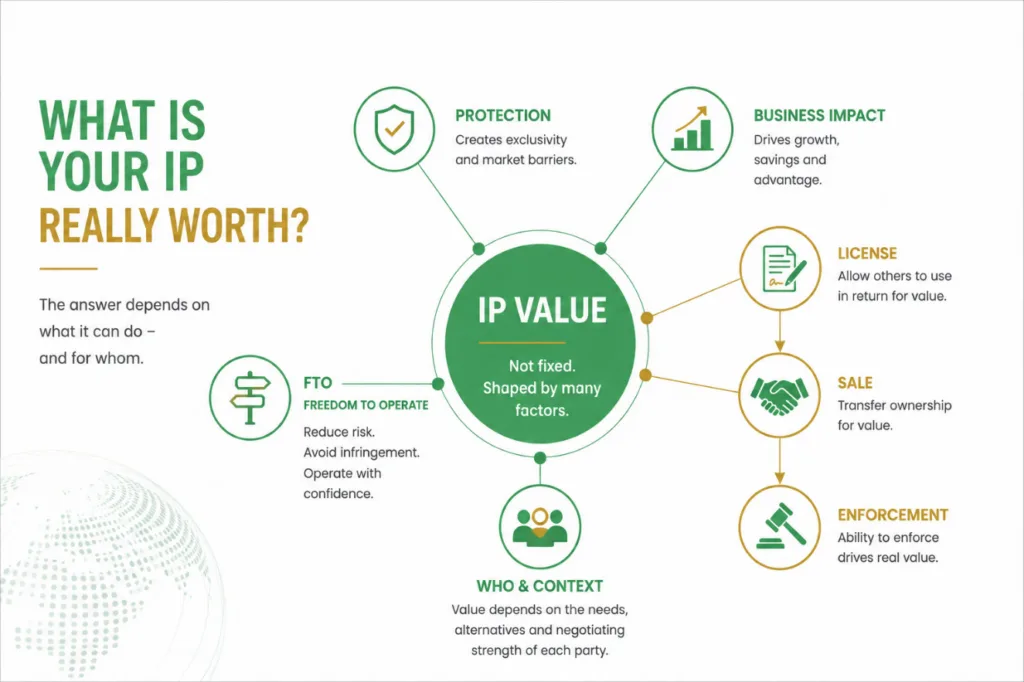
IP value is not fixed. It reflects what the asset can do, how it can be exploited or enforced, and the circumstances of the parties
1. The Three Conventional Starting Points for Valuation
- Cost – What would it cost to reproduce or replace the asset?
- Market – What have genuinely comparable assets sold or licensed for?
- Income – What future economic benefit is the asset expected to generate or save?
Each tells us something useful. None, standing alone, accurately tells us what the IP is worth.
The Cost Approach — What Did It Cost?
The cost approach considers what it would cost to reproduce or replace the asset.
For technology, this might include R&D, engineering time, failed experiments, materials, outside expertise, employee costs and patent prosecution expenses.
This information can be useful, particularly in negotiations. If a potential licensee would have to spend several million dollars and lose three years developing an alternative technology, that tells us something important about the value of having access to the IP today.
But the cost approach has an obvious weakness: as earlier pointed out, what you spent creating something does not tell you what somebody will pay for it. Five years and €2 million spent developing unsuccessful technology do not make it worth €2 million (consider Raychem’s point of view in the case study involving P&G and KC).
Conversely, an elegant solution developed inexpensively may prove enormously valuable.
Cost therefore provides information—not necessarily value.
WIPO’s course on Advanced IP Asset Management (DL450 Module 4) aptly explains the cost method as follows:
The Cost Approach is based on the principle that there is a direct relation between the costs expended in the development of a patent and its economic value. There are three major variants of the cost method:
- the historic cost method;
- the replacement cost method; and
- the replication cost method.
The historic cost method measures the costs incurred through the development of the IP, at the time it was developed. The historical costs are relevant when using a historical cost-based accounting systems or where taxation methods dictate their use.
The replacement cost method calculates the value of a patent by calculating the amount of money that would be paid, at the present time, in order to recreate the functionality or utility of the patent. The costs of failed and unsuccessful research are not included and this calculation method.
The replication cost method calculates the value of a patent by calculating the amount of money that would be necessary to construct an exact replica of the patent. The whole cost of research and development must be included in this calculation, including the costs of, for example, unsuccessful prototypes (see Intellectual Property Valuation at http://www.ip4inno.eu/index.php?id=336 page 3).
In the last two methods, present cost-prices are taken into account, i.e. the expenditures as of the current or the valuation date and not the historical costs at the time when these expenditures were initially incurred.
The cost approach is based on the economic concept of substitution. A purchaser will never pay more to buy an IP asset than she would pay to obtain a substitute of equal utility. The cost approach is rarely used to value IP. This is because the cost of developing a product is rarely correlated with the value of the intellectual property that was the basis for the technology. It also ignores the ‘monopoly premium’ that IP rights provide as cost predates the IPR. There are several problems using the cost approach. The invention that was the most expensive to develop is often not the most successful patent. It is a limited approach as it only takes one factor (cost) into account and it is hard to calculate the actual development costs for the IP asset. The cost approach is retrospective in nature as it does not consider the future risk that the IP asset will become obsolete as newer technology develops thus losing value. The cost approach may not properly value the period the new equivalent technology may take to develop as well as the risk that it may not be possible to create a competing technology.
The Market Approach — What Have Similar Assets Sold For?
Much like in real estate, the market approach looks for comparable transactions. What have similar patents sold for? What royalty rates have been paid for comparable technology? What happened in similar acquisitions?
This sounds straightforward until one searches for a genuinely comparable patent. Unlike the real estate market where there are numerous comparables and extensive publicly available data going back several decades, this is not the case when it comes to innovations, which by definition are new, unique, and essentially without comparables.
Moreover, patents differ in claim scope, remaining term of protection, technical importance, legal strength (validity), geography and commercial application. Licensing agreements differ in exclusivity, markets, royalty bases, cross-licenses, litigation history and dozens of other terms.
Industry royalty rates are not typically published and are more likely to be known informally, “through the grapevine.” They can nevertheless be useful in establishing a range but should be treated merely as indicators rather than definitive benchmarks.
WIPO’s course on Advanced IP Asset Management (DL450 Module 4) aptly explains the market approach as follows:
The market approach assumes the efficiency of free markets of willing buyers and sellers for determining the value of patents. In a free market for an IP asset, there is competition and equilibrium. The market forces of supply (sellers) and demand (buyers) will reach an equilibrium point, which is how the market price of the IP asset is determined. Clearly, each IP asset is unique and is not fungible so this approach establishes the price by analogy to the market price for similar IP assets. Therefore, when applying the market approach one should locate examples of analogous (comparable) assets that were traded among willing buyers and sellers, and then based of those values, estimate the value of comparable intellectual property.
The Market approach is limited as it is not that easy to gather data associated with patents, which are not already priced and traded. Secondly, it will be difficult to find a fair market price if the technology in question is fundamentally novel, and there is no analogous technology. However, if the patent is an improvement patent in a well-developed or mature industry, then the market approach of using comparable patents may be useful. When using the market approach, remain aware of the fact that every patent is unique and that accurate value evaluations based on comparisons to other patents are fraught with difficulty. Moreover, very often the price information about deals concerning analogous assets is kept secret and cannot be used for evaluation purposes (even when such assets and deals are at hand).
The Income Approach — What Money Will It Make or Save?
The income approach asks what future economic benefit the IP is expected to produce and what those future benefits are worth today.
The benefit might be additional revenue. But it could equally be higher margins, reduced manufacturing costs, avoided royalty payments, increased market share or profits that would disappear without the IP.
One particularly useful exercise for an SME is a simple “with and without” analysis: what does the business earn with the IP compared with what it would earn without it?
The difference begins to identify the economic contribution of the asset.
Another commonly used approach is relief from royalty. If the company did not own the IP, what would it reasonably have to pay an independent third party to license it? The avoided royalty represents an economic benefit of ownership.
The apparent simplicity of the income approach can, however, be deceptive. Forecasting revenue five or ten years into the future involves assumptions about market size, competition, pricing, technological change and commercial execution. Those future earnings must then be adjusted for risk and discounted to their present value.
Should the assumptions change, the valuation can and likely will change dramatically.
WIPO’s course on Advanced IP Asset Management (DL450 Module 4) aptly explains the income method as follows:
The income approach determines the value of a patent by discounting the future economic impact at the appropriate discount rate over the life of the IP asset. The methods under this category are all centred on evaluating these future cash flows and then discounting them back at a discount rate to achieve a present value. There are many income-based valuation methods, including the discounted cash flow approach and the relief from royalty approach.
The discounted cash flow approach attempts to determine the value of the patent by computing the present value of future cash flows from the patent, over its projected useful life during the patent period. The relief from royalty method measures the royalty that the company would have to pay for licensing-in the IP being valued, from a third-party. In order to determine the relief from royalty rate, you must calculate, using your best estimate, the expected royalties for each year of the IP asset’s economic life then deduct the costs, for example taxes, if any then if necessary, apply the appropriate discount rate, Frequently, your best estimate of the yearly royalty rate will be based on industry standards and previous transactions.
The concept behind the discount rate is that the present value of €1000 today is worth more than €1000 a year from now or in the case of patents the cash value of the projected income 20 years from now (or the projected useful life of the patent). In the context of IP, the discount rate is determined by the risks associated with the future value of the technology in a dynamic innovative marketplace and of course, consumer preferences. Selecting the discount rate is a matter of business judgment informed by your best judgment of the likelihood of future events. So, if one values the changes in inflation, interest rates, and market risk (discount rate “r”) at 10% then the present value (PV) of €1000, one year (n=1), from today is €909.09 [1000/(1+.10)].
This calculation will of course become more complex over longer periods of time so the formula is:
PV= FV/(1+r)n, where FV is the future value.
So, if the period was 20 years the present value (PV) of €1000 would be €1000/(1+.10)20=€1000/6.73=148.59 (allow for rounding errors).
Relevant considerations include enforceability, prior art, the possibility of validity challenges, the breadth of the claims, the ability to detect infringement and the practical ability and willingness of the owner to enforce the right.
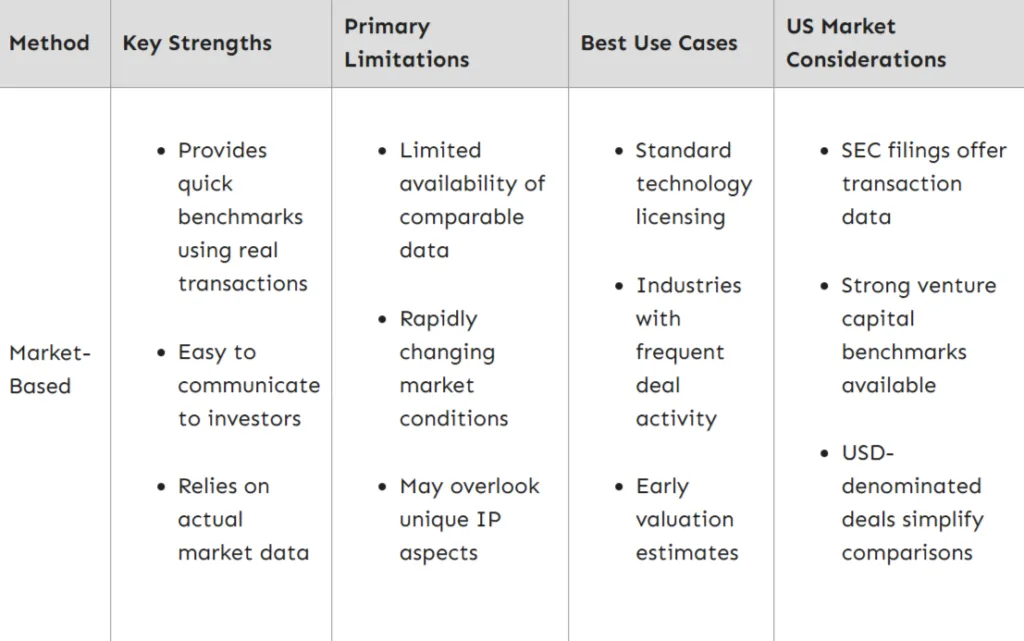
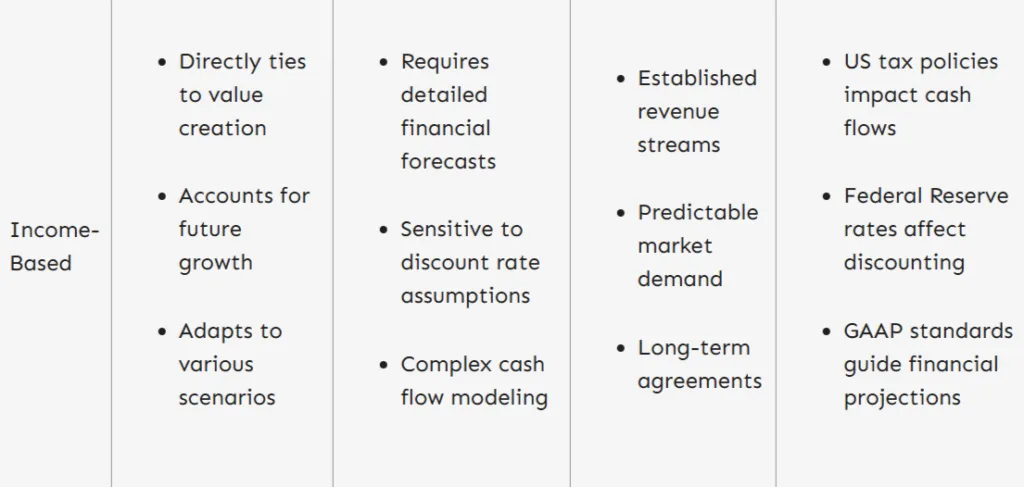
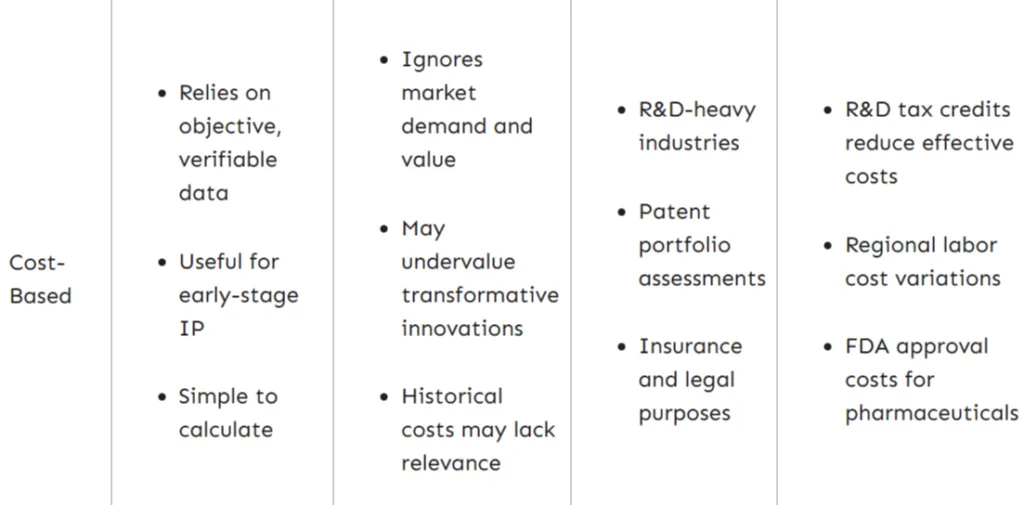
The Phoenix Strategy Group, on their website(5 Methods for Licensing Valuation – Phoenix Strategy Group), nicely summarize the strengths and weaknesses of these three valuation methods.
2. Other factors affecting value
How strong is the patent itself?
A brilliant technology protected by a weak patent is not the same asset as brilliant technology protected by a strong patent. What makes a patent strong or weak includes considerations such as the breadth of the patent claims, the impact of the prior art on validity and claim interpretation, prior infringement cases and challenges to validity in litigation and the resultant outcome, commercial success, arm’s length licenses under the patent and the even number of occasions that the patent was cited as prior art against subsequent applications.
The value associated with Freedom to Operate (FTO)
IP strategy is not concerned only with stopping other people.
Sometimes its greatest value is allowing you to operate (in the case study, P&G initially purchased the Raychem patent to protect its own FTO).
A patent acquisition or licence may provide the freedom to enter a market that would otherwise be blocked. A cross-licence may resolve competing patent positions and allow two companies to continue doing business. Acquiring a portfolio may reduce litigation exposure or remove uncertainty surrounding an important product launch.
That value may never appear as royalty income. Management may quite rationally conclude that paying several million dollars for a licence is preferable to redesigning a product, delaying market entry or facing the uncertainty of litigation.
In a highly competitive market, the guarantee of freedom to operate (by acquiring a patent or licensing it in) can therefore be every bit as commercially important as exclusivity.
Blocking, Cross licensing and more
Consider a patent that generates little direct licensing revenue but prevents a competitor from entering your most profitable market; a patent portfolio that allows an SME to negotiate a cross-licence with a much larger competitor.; a patent that makes a start-up substantially more attractive as an acquisition target; or a patent that enables an organization to join a patent pool.
3. Non-traditional valuation methods
Real options methods are derived from financial securities concepts. As adapted for IP assets, real options methods are very complex and take into consideration that patents have uncertain values that likely depend on various discretionary future implementation decisions. Options methods include acquisition methods, the Black-Scholes method and the binomial option pricing method, to name a few.
In the context of pharmaceutical, WIPO defines it thus:
The real options method captures the value of strategic flexibility, such as whether to continue, delay, or abandon a development program as new data become available. In biotech, where uncertainty is high and staged decisions are common, this method allows valuation to reflect the option like nature of clinical trial investment. (Intellectual Property Valuation in Biotechnology and Pharmaceuticals)
Decision Trees Methods also take into account the uncertainties associated with the future value of current innovations. The decision-tree valuation approach plots out the various possible scenarios allowing for distinct valuations in each case:
Mapping out potential scenarios and their associated probabilities and values. Decision trees are visual representations of different possible scenarios and their outcomes, allowing for a structured analysis of complex decision-making processes. In IP valuation, decision trees can be used to map out various potential paths for the development, commercialization, or licensing of intellectual property. This tool helps valuators and stakeholders visualize the potential consequences of different decisions, making it easier to identify optimal strategies and understand the potential risks and rewards associated with different courses of action.
Monte Carlo simulation is another valuation technique used when the future value of an IP asset depends on several uncertain variables:
[Monte Carlo] involves running multiple scenarios to account for various uncertainties. Monte Carlo simulations are powerful computational tools that allow valuators to model complex systems with multiple variables and uncertainties. By running thousands of simulations with different input parameters, valuators can generate a distribution of possible outcomes, providing a more comprehensive view of potential IP values. This approach is particularly useful in situations where there are numerous interacting factors affecting the value of intellectual property, as it can reveal patterns and insights that might not be apparent through more traditional valuation methods.
Other methods worth mentioning are also derived from methodologies used in corporate finance as predictors of future value. These include the Google acquisitions method, probability weighted expected return method, the Markov valuation method, Bayesian analysis, and binomial lattices to name a few.
4. Conclusion
This booklet is intended to highlight the most important considerations for SMEs, IP managers, in-house counsel and, more generally, anyone involved in managing intellectual property as a business asset. If there is one central message to take away, it is that, in today’s innovation-driven economy, intellectual property is often among a business’s most important assets, making effective IP asset management an increasingly important part of overall business strategy. Identifying, protecting and maintaining IP is only part of that process; businesses must also understand the commercial and strategic value those assets represent.
In this concluding chapter, I have emphasized the important role that valuation plays in effective IP asset management. Whether decisions involve investment, licensing, acquisition, sale, enforcement, financing or the allocation of resources within an IP portfolio, an understanding of value helps ensure that IP decisions are aligned with broader business objectives. Ultimately, effective IP asset management means recognizing IP not simply as a collection of legal rights, but as a portfolio of business assets that should be actively managed to create, protect and enhance value.